Some companies secure top tech hires by offering higher salaries. Others win by showing candidates exactly what the role offers: scope, ownership, and team structure, before compensation is even discussed.
If your budget isn’t leading the market, your tech hiring compensation strategy needs to lead with the parts of the role that actually make a difference to candidates, such as what the work entails, the impact the hire will have on the product, systems, or team delivery, and why this team is worth their time.
Too often, hiring teams wait until the offer stage to communicate that message. At STACK IT, we work with founders and hiring managers to build that narrative before the role goes live. That’s part of how we run our full-time IT recruiting service.
Strong candidates don’t wait for the offer to make up their mind. They decide early. Most often, once they’ve seen who they’ll work with, what they’ll build, and how the team runs.
The Challenge for Most Hiring Managers
We joined a search where the hiring manager couldn’t explain how this role was different from the last three. Candidates asked why it was worth their time. The team said things like “you’ll wear a lot of hats” and “we’re growing fast.” Two finalists dropped out.
Once we clarified what the hire would own, what needed fixing, and what impact they’d have in 90 days, the next candidate said yes.

In a recent labour force survey, 72.5% of Canadian top-quartile earners said they felt their compensation was appropriate. Among lower earners, that number dropped by over 15 points. The drop in sentiment was attributed to how well the offer aligned with the actual work. The salary didn’t change. The framing did.
When compensation is tight, many teams downplay it, or try to cover it with generalities: “We’re moving fast,” “There’s lots of upside,” “We’re excited about where this is going.”
That’s not enough, especially for experienced candidates who’ve been burned before. They’re not comparing brand names. They’re thinking about what they’ll build and who they’ll do it with.
The offers that lose out aren’t always the lowest. They’re the ones who leave too much unsaid.
Tech Hiring Compensation Strategy: Screening & Coaching
Before we launch a search, we pressure-test the pitch. We ask:
- What will success look like in 6 months?
- What will this person actually change, fix, or lead?
- Who’s on the team now? What’s the handoff risk?
- What’s the day-to-day workflow? Is it structured and meeting-heavy, or more independent and asynchronous?

We walk hiring teams through how to talk about your tech hiring compensation strategy — a core part of attracting and closing top tech talent — and value in plain terms, especially when salary isn’t the main draw. If the answers are vague, we work through them. Because the candidate will ask. And if you can’t address those details, strong candidates will notice and start backing out.
When the budget is a constraint, the offer has to carry weight. That only happens when it’s honest, specific, and well-defined.
Success Story: Closing a Software Engineer Without the Top Offer
A SaaS team had just lost two engineers to better-paying companies. This next hire would own the rebuild, report directly to the CTO, and establish the technical direction. But none of that was communicated in the early calls.
We reworked how they presented the role:
- Lead the rebuild of our core platform
- Work directly with decision-makers with no layers of approval
- Set the standards the rest of the team will follow
The next candidate came in with three other offers. It was a tough market for software engineers, but the details won out. They joined. They’re still there.
What Tech Candidates Ask (and Why It Matters)
Good candidates don’t only ask about salary. They ask:
- Who do I report to, and how do they give feedback?
- What problems need solving right away?
- How much say will I have in how we build?
- What’s already working, and what’s still a mess?
If your answers are vague or inconsistent, you’ll lose them. We prep hiring teams to answer those questions the way a strong candidate would expect, with clear and direct answers.
Success Story: Winning a Data Engineer With a Clear Message
A health tech company kept getting outbid. We asked: What’s different about your data stack?
Here’s what came out of that simple question:
- The hire would build the automation layer from scratch
- Their work would impact patient care directly
- They’d have a seat at the table with tech leadership
We worked this into their interview flow. For data engineers, autonomy and impact often outweigh base compensation. The candidate said yes. They now lead that stream.

What Not to Say (And Why Candidates Walk)
We’ve seen these lines derail otherwise decent searches:
- “We’re just getting started, but there’s lots of opportunity.”
- “We move fast and wear a lot of hats.”
- “We’re like a family here.”
What candidates hear:
- Undefined role
- No clear ownership
- Ambiguity that gets expensive later
What to say instead:
“You’ll own X from week one and help us build Y from the ground up.”
“We run short planning cycles. Engineers are in the room before decisions are made.”
Specifics build trust. Vague language triggers doubt.
How to Frame the Opportunity Upfront
A strong tech hiring compensation strategy doesn’t rely on leading with salary. You need to show what makes this role worth choosing, what the candidate will take on, who they’ll work with, and how the work actually gets done. That means:
- Show how the team works today, warts and all
- Be up front about what’s solid and what’s still being figured out
- Spell out how the role grows: what they’ll take over, how their responsibilities expand, and what decisions they’ll own by month six (for example)
- Say who gives feedback and how decisions get made

We help hiring teams get specific about what the role offers. Think about who the hire reports to, what they’ll take on, and how they’ll be supported.
What works:
“We know we’re not the top offer. But you’d own the system end-to-end, work with engineering leadership, and grow into a lead role in under a year.”
What doesn’t:
“We’re building something exciting, and the culture’s great.”
Interview Consistency: Keep Expectations Clear
Even if the pitch is good, it falls short when the interview panel isn’t on the same page. We’ve seen it: one person talks about mentoring juniors, the next says the team is still forming. That kind of inconsistency raises serious questions about the entire role.
We help teams:
- Agree on how to describe the role and the team
- Prep interviewers to answer candidate questions clearly
- Catch and correct misalignment early so the candidate hears a clear, consistent message throughout
In our experience, the hires who stay long-term are the ones who heard a clear, consistent message from the very first call.
Why the Offer Stage Isn’t Where Decisions Get Made
We’ve seen high-salary offers get declined because the job didn’t match what was sold. Experienced candidates can often tell when the role doesn’t match what has been described. They’ve seen roles that overpromise and underdeliver.
A clear pitch wins more than a padded one. According to Statistics Canada, 80% of employed Canadians rate their average job satisfaction as reasonable, with a score of 7.7 out of 10. That level of satisfaction doesn’t come from compensation alone. It comes from knowing what you’re walking into and feeling like your contribution matters.
Make sure candidates walk away knowing:
- What they’ll do and who they’ll do it with
- How much control they’ll have
- What success looks like in the first 90 days
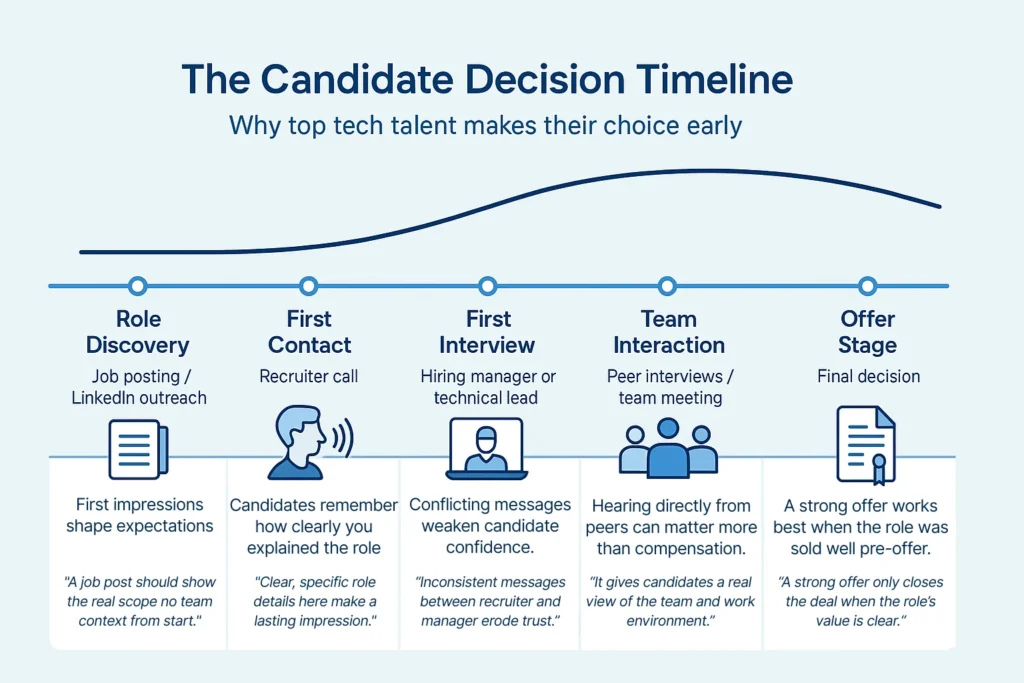
When candidates see exactly what they’ll work on and how they’ll contribute, compensation becomes one factor and not the only one.
Hiring with budget constraints?
Our tech hiring compensation strategy framework ensures you communicate role value early, making salary just one part of the decision.
Let’s talk about how to make your opportunity stand out without stretching your compensation. Also see the STACK IT Salary Guide for role-by-role expectations and practical compensation framing.