

It’s 8:47 a.m., and your inbox is already overflowing. Two hundred new applications arrived overnight, and most have the same fonts, same phrasing, same polished enthusiasm. You scroll through line after line of “driven professionals” and “results-oriented developers,” each one indistinguishable from the next.
One cover letter feels oddly familiar. Another starts with a phrase you’ve read three times this week. You pause, exhale, and hover over one that stands out. Not for its creativity, but for the note in the header: “AI-assisted.”
You can’t help but wonder: if everyone sounds perfect on paper, how do you tell who can do the work?
If this sounds familiar, you’re not alone.
Why Resumes All Sound Alike
Let’s be frank. AI isn’t coming for recruiting, it’s already here.
Nearly every resume today shows signs of AI editing, from polished bullet points to identical summaries that all sound alike. Even the typos are disappearing. Most resumes seem to have been edited by the same Grammarly tool.
As of late 2024, 46% of Canadian workers reported using generative AI. That’s up from 22% the year before. Platforms and workflows are shifting fast.
In STACK IT’s 2025 applicant survey, nearly 9 in 10 tech candidates reported using AI somewhere in their application. Examples include: resume phrasing, cover-letter generation, and interview prep (STACK IT internal survey, 2025).
The challenge isn’t spotting AI, it’s confirming who can deliver when the work begins. For recruiters and hiring managers, this is the new baseline. AI editing is everywhere, and that’s fine. What matters now is building processes that separate honest communication from “AI-assisted”. For companies looking to hire tech talent in a competitive environment where every resume appears flawless, the real challenge lies in human verification.
The Rise of AI-Written Applications
The numbers are striking. Industry reports show that more than half of job seekers now use AI to craft or refine their resumes. Recruiter discussions across forums reveal similar patterns: identical formatting, cloned phrasing, and mass‑generated submissions that overwhelm applicant tracking systems.
STACK IT’s own data supports this.
In our 2025 pipeline, the majority of resumes show AI editing; a small minority include inconsistencies. From May–October 2025, ~68% showed AI edits; ~15% had inconsistencies (STACK IT intake review).
Most applicants use AI responsibly to refine presentation, but a small group misrepresents experience completely.
So the response has to be practical: verify what matters.
In financial services, we’re seeing entire applicant pools that look flawless on paper, yet only a few can explain how they’ve supported those systems. The same pattern appears across tech‑driven industries where accuracy and accountability are critical.
This is what it looks like for recruiters sorting through hundreds of applications every week.
The Problem With ‘Flawless’ Resumes
AI tools have made resume writing easier, but they’ve blurred the line between skill and style. Recruiters see it every day. Great formatting and a confident tone that masks a weak understanding.
Recruiters describe subtle cues: the pause before a technical question, the perfect but empty phrasing, the silence after a follow‑up. You can almost hear the script in a candidate’s head, and that’s your cue to dig.
Our internal analysis shows recruiters spend 23% longer validating skills when resumes display AI-style phrasing (STACK IT internal performance audit, 2025). That extra effort goes into verifying whether the candidate can truly deliver, not just describe, the work.
Recent recruiter stories show the same pattern: cloned resumes built from LinkedIn profiles, AI‑generated cover letters recycling corporate jargon, and bots flooding inboxes with look‑alike submissions. When everything sounds perfect, it becomes harder to spot people who know their work.
The goal isn’t to reject AI. It’s to adapt. When every resume sounds strong, the hiring edge comes from understanding how people think and not how they write.
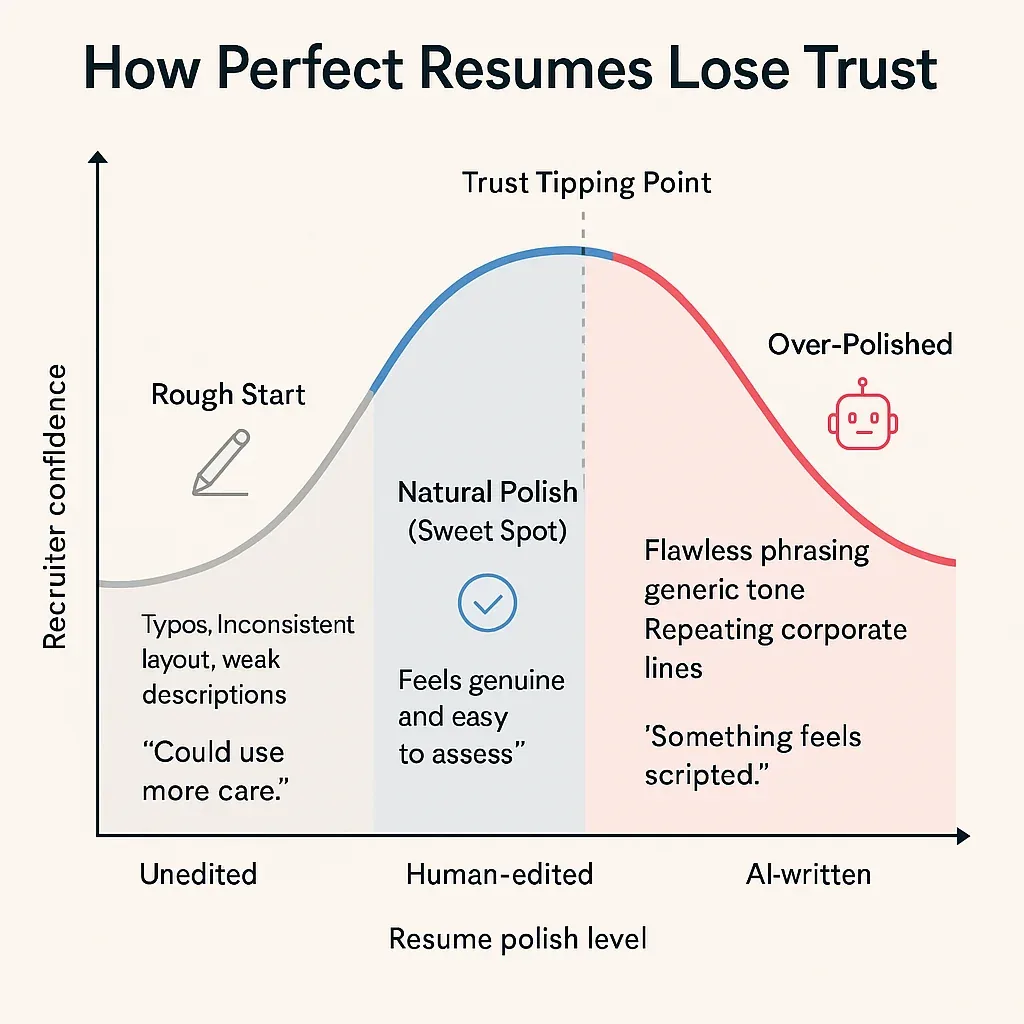
Recruiters already see the difference. The best indicators are in reasoning. A candidate might describe optimizing an API, but when asked why they chose one framework over another, the sweating begins. Those small droplets of sweat separate prompt‑driven from genuine responses. Good recruiters use those pauses like detectives.
One recruiter recalled an applicant who described building a “Kubernetes microservices ecosystem”, but couldn’t explain what an ingress controller does. Another admitted to using ChatGPT for phrasing but explained their debugging process with no issues. The difference wasn’t the tool, it was transparency and building trust.
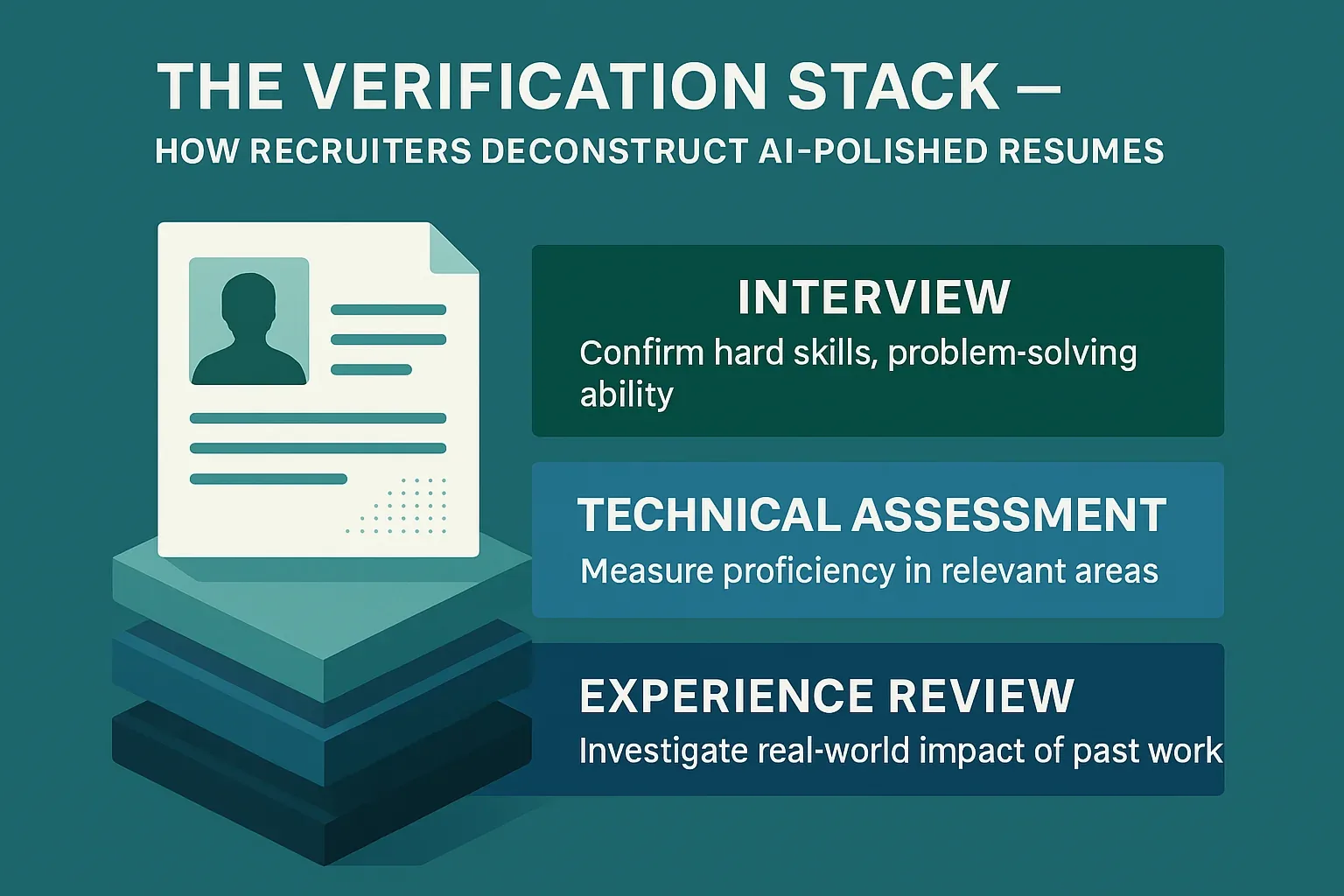
That moment shows the difference between polished writing and real knowledge, and it’s where STACK IT’s process begins. Strong recruiters rely on smart questions to ask in an interview that reveal reasoning instead of rehearsed answers.
It happens often, and we love sharing these examples. Here’s another:
Halfway through an interview, something feels off. The candidate’s resume says all the right things, but each answer sounds rehearsed. You switch gears and ask about a project decision that isn’t on the page. Silence follows. The illusion fades.
How STACK IT Finds Real Tech Talent
At STACK IT, our recruiters follow one principle: Technical Precision. Cultural Fit. That’s Our STACK.
Whether hiring a Software Engineer, Data Analyst, or DevOps lead, our process stays human, structured, and context‑driven.
We don’t score phrasing. We look for signs of competence:
- Technical precision: Can they explain the reasoning behind their work?
- Communication detail: Do they show understanding through applied examples?
- Cultural fit: Will they add value to the team dynamic?
This consistency across contract and permanent searches keeps the process fair. Every candidate, AI‑edited or not, is evaluated the same way.
Real skill is apparent in conversations. Data Engineers can talk pipelines all day, but if they can’t describe data lineage in plain terms, that’s borrowed phrasing.
A developer explaining a complex bug fix doesn’t sound rehearsed. They sound real. The pauses, the laugh when recalling what went wrong, and the ability to adjust mid‑answer all reveal the truth.
Inside STACK IT’s Interview Process
Context‑Based Screening
Our recruiters use intake calls to focus on project scenarios: Why did you choose that architecture? How did you debug it? Ownership can’t be faked when someone explains their own choices. “Walk me through the toughest bug you couldn’t fix” often tells more than any test.
Live Validation
We use BrightHire to record interviews, allowing us to focus fully on the discussion instead of taking notes. Later, we replay key clips and catch what automation can’t. Every submission is double‑reviewed by our team.
According to STACK IT’s 2025 live-validation study, incorporating these recorded interviews reduced false-positive hires by 37% compared to resume-only screening (STACK IT live-validation pilot analysis, 2025).
Decision and Fit
Finally, we examine the alignment of skills and teams together. The best hire isn’t the smoothest talker, it’s the one who works well with others and stays accountable. In the end, we’re not comparing resumes. We’re comparing people.
This model doesn’t penalize AI users. It values substance over style and experience over presentation.
Teams using this approach see clearer pipelines. Interview‑to‑hire time drops, and new hires settle faster. Recruiters also see fewer early withdrawals because candidates are screened for ownership and adaptability, both qualities no cover letter can fake. That reduction in false positives saves time and prevents the cost of a bad hire.
Be Upfront About AI. We Are.
Ontario’s Bill 190 requires transparency around AI use in hiring. STACK IT already includes full disclosure in all job postings.
“STACK IT uses AI‑assisted tools to support candidate screening and interview note analysis. All assessments and decisions remain human‑led.”
We use AI tools carefully. Candidates deserve transparency about automation, and clients need assurance that people make the final call.
A candidate once asked, “Are you using AI to evaluate me?” and they deserved a direct answer. Transparency builds trust. Clients should understand where automation is beneficial and where recruiter judgment is necessary.
How Hiring Teams Can Adjust
If AI is now part of the landscape, recruiters need to adjust their filters:
- Assume AI polish, but check authenticity. When someone claims to have led a migration, ask how they handled the rollback. You’ll know fast if it’s real.
- Ask scenario questions. Go deeper than software: “How did you decide which one?”
- Listen for pacing. When answers come too fast, it might be scripted, because reasoning takes a few more seconds.
- Be open about AI. Transparency keeps interviews straightforward and fair.
- Keep recruiter consistency high. The evaluation method should be similar regardless of the candidate.
Teams that apply this structure see practical benefits. Interviews move faster, shortlists improve, and hiring cycles shrink. It’s a better experience for both recruiters and candidates, and it shows that people‑first recruiting still works.
Across STACK IT’s 2025 dataset, AI adoption among applicants reached 89%, recruiter validation time rose by 23%, and false-positive hires dropped 37% after live-validation interviews were introduced (STACK IT Candidate Screening Process, 2025). Together, those shifts confirm that AI has changed how resumes look, but not how real hiring should be done.
If your process can’t tell the difference between a prompt and a person, it’s time to change it.
The Future of AI‑Led Hiring
AI’s role in recruiting will continue to grow, but so will the need for accountability. Screening will combine behavioural and context clues, but it won’t replace recruiters. It will, however, strengthen their decisions.
New ATS systems like Ashby and Greenhouse are already testing fraud‑detection features that track application metadata. Legislation similar to Bill 190 is expanding globally, pushing companies to stay transparent in hiring.
The companies that adapt best will be those that maintain human judgment, combining structured, transparent screening with technology support led by experienced recruiters.
The same pattern appears in healthcare and life sciences recruiting, where credentials and data accuracy matter as much as technical ability. A polished line on a resume isn’t proof of readiness, and that’s where AI can mislead both sides.
Use AI. Trust Humans
The market can’t undo AI’s presence in resumes, nor should it. But it can move forward. The strongest hiring processes leverage AI to augment recruiter insight and context.
Recruiting has always been about people. The next phase reinforces that. AI can speed up initial steps, but only recruiters can confirm skill, judgment, and fit. The goal isn’t avoiding AI; it’s using it responsibly while keeping people in control.
After reading this, we hope you’ll feel the difference in your recruiting. AI hasn’t replaced intuition, it’s made it more important, and experience still matters most.
At STACK IT, we’ve built our approach around that. When everyone looks good on paper, what counts is how they think, communicate, and deliver.
Would your current hiring process catch a candidate who can explain a tool but not apply it?
How many resumes in your pipeline sound perfect but lack ownership language?
About the Data
Insights cited in this article come from the STACK IT live-validation pilot analysis (2025), an internal review of 1,240 candidate interviews and 275 client placements conducted between January and September 2025. Metrics were drawn from BrightHire interview analytics, Workable ATS logs, and client quality-of-hire surveys.
All participant data was aggregated and fully anonymized. No personal information was shared outside STACK IT, and all analysis was performed in accordance with our internal privacy and AI-use guidelines aligned to Ontario’s Bill 190 disclosure standards.