

“Headcount’s frozen,” one manager said.
“So what do we do? We can’t leave this role open,” another replied.
The CTO added, “If we wait for a permanent hire, it’s months. We don’t have that kind of time.”
Then someone asked the question on everyone’s mind: “Should we look at contract support instead?”
These are the kinds of conversations happening in Canadian boardrooms where leaders decide whether to wait for a permanent hire or move now with contract talent.
Hiring managers often wrestle with whether to bring in a contractor or commit to a permanent hire. Both models have clear advantages, but context is everything. At STACK IT, we’ve seen situations where contract hiring outperforms full-time staff recruiting by protecting delivery, reducing risk, and giving companies breathing room when conditions aren’t stable.
The real question many leaders ask is simple: is contract hiring better than full-time in this situation?
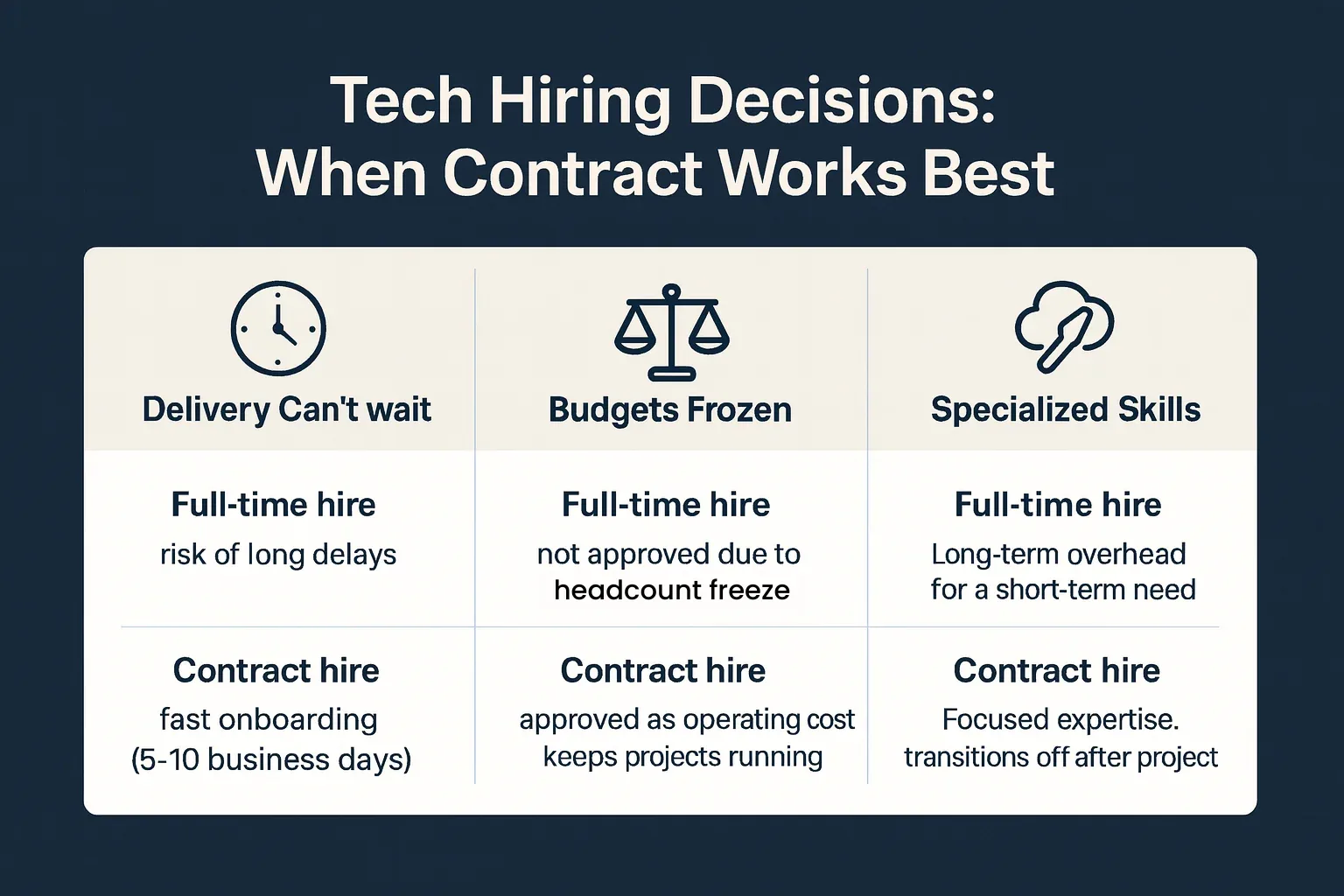
Here are three situations we encounter most often: instances where waiting for a permanent hire would compromise timelines, budgets, or compliance. In each case, contract recruiting proved to be the practical way forward, providing teams with the continuity they needed to keep projects on track.
Scenario 1: When Delivery Can’t Wait
Permanent searches take time. Even with fast sourcing, notice periods and lengthy interview cycles can leave teams waiting for months to find the right hire. That’s a problem when product deadlines are fixed or infrastructure needs attention now.
We’ve seen this with engineering teams under pressure to hit release milestones. Waiting for a full-time hire would have put delivery at risk. Instead, a contract engineer was placed within two weeks, having already been vetted for both technical depth and cultural fit. Work continued without the backlog growing. At that moment, contract hiring was the better option over full-time employment because the time to fill the position was everything.
Why contract works here: vetted contractors can be onboarded in days, not months. With STACK IT acting as the Employer of Record, payroll and compliance are already handled, allowing teams to focus solely on delivery. This is the backbone of true employer of record recruiting, giving teams confidence that every placement is fully supported.
Additional insight: Delays cost more than a salary. Every week that a key role stays open, teams lose measurable productivity. Our calculator shows the cost of delaying a hire often runs into six figures within a quarter, making a two-week contract onboarding a clear win over, for example, a 12-week vacancy.
Mini case: A SaaS company facing a tight product launch deadline onboarded a contract DevOps engineer within eight business days. That engineer stabilized CI/CD pipelines and cleared a release backlog that would have delayed the launch by six weeks.
Scenario 2: When Budgets Are Tight or Headcount Is Frozen
Many organizations enforce headcount freezes, especially in uncertain markets. Yet projects don’t stop. Leaders still need to deliver features, maintain systems, and advance roadmaps. Hiring a permanent employee may not be an option, even when the work is critical.
In these cases, contract hiring provides teams with a way to add capacity without increasing their full-time headcount. We’ve supported clients where finance approved a contract role but would not sign off on an FTE. STACK IT carried the employment risk, ran payroll, and managed compliance, while the team gained the resources they needed to continue moving forward. It’s another real-world case where leaders debated whether contract hiring is better than full-time and found the contract route kept projects alive without adding to headcount.
Why contract works here: contractors appear as an operating expense, not a permanent headcount addition. That flexibility maintains budgets while ensuring timely delivery.
Additional insight: With STACK IT as Employer of Record, we also manage employment standards compliance, deductions, and backfill if a contractor exits early. These additional benefits reduce financial surprises and give finance leaders confidence to approve contract capacity.
Mini case: An enterprise under a hiring freeze needed analytics coverage to maintain regulatory reporting. STACK IT placed a contract data analyst who cleared reporting backlogs and made sure compliance deadlines were met, without breaching headcount restrictions.
We’ve seen the same in financial services, where headcount freezes are common but compliance reporting doesn’t wait. A contract Data Analyst can ensure reports are accurate and on time, avoiding penalties while the organization sorts out longer-term staffing needs. For companies under similar pressure, sometimes the smartest move is to hire a data analyst on a contract basis to solve the issue.
Scenario 3: When Specialized Skills Are Needed Temporarily
Some roles are critical for a specific project but not sustainable as a full-time position. Examples include a cloud engineer for a migration, a cybersecurity specialist for an audit, or a program manager for a short-term integration.
We’ve placed contractors in each of these cases. They were thoroughly vetted for technical expertise and cultural fit, contributed to the project, and signed off once the work was completed. A full-time hire would have either been underutilized afterward or added unnecessary long-term cost. For leaders facing this, the choice came back again: is contract hiring better than full-time when the need is highly specialized but temporary? The answer, tested in practice, was yes.
Why contract works here: contract recruiting brings in highly specialized talent for the window they’re needed, without carrying idle capacity once the project ends.
Additional insight: Hiring managers often assume short-term needs can be covered by internal staff. But no, we’ve seen this stretch teams and burn them out.
Mini case: A healthcare organization required expertise in cloud migration. STACK IT placed a contract cloud engineer with multi-cloud experience, who completed the migration on time and trained internal staff to manage the new environment before rolling off. Healthcare organizations face similar challenges during EMR upgrades or cloud migrations. A contract Cloud Engineer with proven multi-cloud experience can complete the work, transfer knowledge, and transition off all without adding a permanent headcount that may not be needed later.
Common Misconceptions About Contract Hiring
- “Contractors aren’t vetted as thoroughly.” At STACK IT, contractors undergo the same technical and cultural screening as permanent candidates, including scenario-based interviews and team reviews.
- “Contractors are only stopgaps.” In reality, many bring senior expertise that accelerates delivery and stabilizes projects until a full-time hire is viable.
- “Conversion is messy.” Our model includes a structured buyout option with monthly discounts, making it straightforward to transition a contractor to a full-time role if both parties see a long-term fit.
Compliance and Legal Considerations
Ontario’s Bill 190 requires transparency in pay ranges and the disclosure of AI use in job postings. STACK IT aligns all contract and permanent postings to these standards, even though smaller firms are technically exempt.
And we’re not alone: 67% of HR professionals see increased AI use as a key hiring trend for 2025, with 77% saying it improves candidate matchmaking, a shift that’s reshaping how firms recruit and screen across all models.
By acting as Employer of Record, STACK IT also manages ESA compliance, remittances, and legal obligations. This reduces risk for clients and ensures that contract hiring stands up under scrutiny. This is especially relevant in the context of contract versus permanent IT hiring in Ontario, where regulatory standards, such as Bill 190, set the tone for compliance.
Candidate Experience and Conversion Path
Contract roles aren’t only built for client flexibility; they impact candidates, too. Many contractors value exposure to diverse projects and the opportunity to transition into full-time roles if the right fit is found. STACK IT’s buyout structure, offered at a discounted monthly rate, provides both the client and candidate with a clear path if long-term employment becomes the goal. Candidates also benefit from structured onboarding, payroll stability, and transparent communication.
For teams, this means contractors arrive motivated and ready to integrate quickly. And for leadership, another consideration is whether contract hiring is better than full-time employment when thinking about long-term workforce planning. Especially, contract recruiting for startups can be a lifeline when headcount is capped but product timelines continue to move forward.
Contract vs. Permanent: A Detailed Lens
| Factor |
Contract recruiting STACK IT EOR |
Permanent recruiting |
|---|---|---|
| Employment model | ||
| Who is the employer | STACK IT is employer of record | Client is employer of record |
| Cost & speed | ||
| Cost structure | Hourly bill rate with margin (OPEX) | One‑time % of base salary (CAPEX) |
| Typical start speed | 5–10 business days | 2–3+ weeks (often longer with notice periods) |
| Risk & flexibility | ||
| Operational risk | STACK IT carries payroll, remittances, and compliance | Client carries long‑term employment obligations |
| Flexibility | Start, pause, extend, or convert as needs change | Long‑term commitment; change requires rehiring |
| Onboarding & conversion | ||
| Onboarding support | Payroll setup, compliance, and backfill guarantee | Client manages onboarding and all HR risk |
| Conversion options | Discounted buyout path to full‑time (monthly reduction) | Not applicable |
| Quality bar | ||
| Screening rigour | Same technical and cultural vetting as permanent roles | Full technical and cultural vetting |
The real decision isn’t “which is better overall?” but “which fits my situation right now?” In conversations with leadership, the question always comes back to: Is contract hiring better than full-time employment, given the pressure we’re under? For readers weighing options, resources like permanent vs contract tech recruiting can provide further perspective on how each model plays out.
FAQ: Contract vs. Full-Time Hiring
How do I know if my project risk justifies a contract hire?
Can contractors transition to permanent roles?
What budgeting challenges indicate a contract role instead of a full-time position?
How do contracts handle compliance and liability differently?
Which roles make the most sense as contract-first hires?
Final Word
Contract hiring is not a replacement for building permanent teams. But in the right context, it can be the smarter move. The key is ensuring the same process in screening and cultural fit that you’d expect for a full-time hire.
Back at that leadership meeting we opened with, the team settled on a path forward. The CTO signed off on a contract engineer, and finance gave the green light since it didn’t affect headcount.
Two weeks later, the contractor was in place, and deadlines were back within reach. No one pretended it was a long-term solution, but it provided the team with exactly what they needed: breathing room to stay on track without blowing the budget or encountering compliance issues.
It answered their immediate question: Is contract hiring better than full-time for this moment? For our leaders, it showed the value of flexible IT recruiting models and the options that adapt to market pressure without locking the company into long-term overhead.
STACK IT applies that standard across both models. We protect delivery, whether the right answer is a contract or a permanent arrangement.