

Hiring the wrong person doesn’t just cost time. According to Statistics Canada, job vacancies in Canada decreased by nearly 18% year-over-year in Q1 2025, dropping from 640,400 to 524,300. With fewer open roles, candidate pools are tighter and every search needs sharper execution.
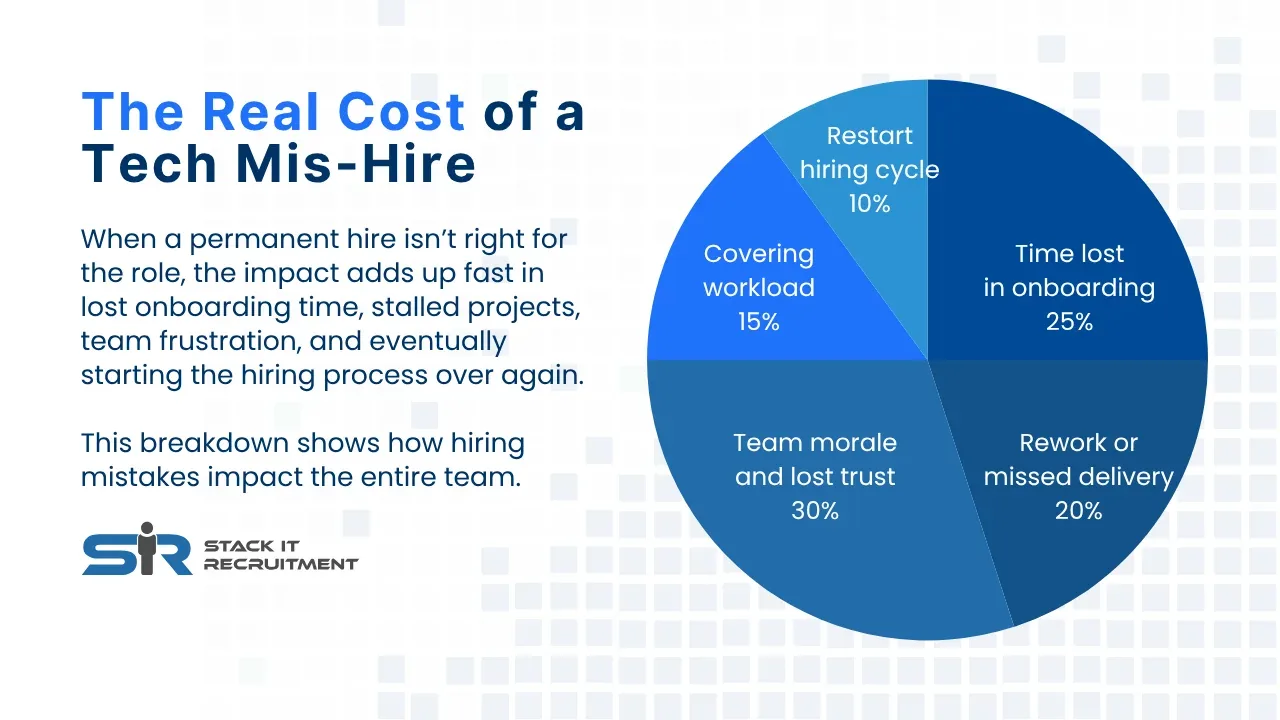
It slows down teams, derails projects, and erodes trust. fx Even experienced hiring managers can make these tech hiring mistakes. Many of them trace back to myths about permanent IT recruitment that do not hold up. F6 How to run BSR Pairs
Fixing tech hiring mistakes after someone’s already started? That’s when it gets expensive. Fixing a requirements error post-production costs 15x more than catching it early. Hiring follows the same rule. Once someone’s in-seat (but doesn’t fit), you’re replacing them and managing their missteps.
These are six tech hiring mistakes we see firsthand. Ones that good teams keep making. Our permanent IT recruiting model is built to prevent them.
1. Treating Candidate Volume as Progress
A hiring manager asks for candidates. A recruiter sends 30 profiles. It looks great, but volume isn’t progress.
The pressure to hire fast hasn’t changed, but the hiring landscape has. Canada now has 2.9 job seekers for every open role, up from 2.0 a year ago. That means more resumes, and more reason to pause before rushing into candidate screening.
We worked with a fintech company that had just made three hires through a volume-based agency. Only one stayed. The others looked fine on paper but couldn’t keep pace with the team. When we took over, we revised the job description and submitted two new applications for data analysts. Both were hired. Both moved the reporting forward within weeks.
What was missing? A pause. A detailed intake process. And a recruiter who knew how to spot what mattered well beyond the candidate’s resume.
2. Mistaking Keyword Matches for Fit
Some recruiters build lists based solely on keywords. But most teams don’t need “someone who knows React”, for example. They need someone who knows how to work in a codebase with legacy debt, unclear tickets, and shifting priorities.
We ask what happens when something breaks at 4 p.m. on a Friday. What they’d do if QA’s behind. How they’ve handled rollbacks in the past.
We once spoke to a candidate who aced every ATS filter. But when asked about rolling back a failed deployment, they froze. They knew the lingo, but couldn’t explain a single decision that mattered under pressure.
What Looks Good At a Glance, But Isn’t:
- A resume full of short tenures without context
- Claims of leading projects without explaining their role in decisions or outcomes
- References that describe “work ethic” but don’t touch on the results
- Over-prepped answers that don’t change when the question does
3. Skipping the Delivery Test
Plenty of candidates hold the right job title. That doesn’t mean they’ve ever been responsible for outcomes when priorities shifted or timelines slipped.
We worked with an e-commerce company who’d burned through three business analysts. The recruiter had never tested how those candidates interpreted vague requirements, dealt with cross-team overlap, or pushed back when expectations clashed. We did. The BA we placed has since led two platform upgrades.
What do we test for? Performance under stress. Communication with competing priorities. The ability to finish, and not just plan.
4. Ignoring How People Work Together
Most screening focuses on tech skills and experience. The better question is: can this person support the people around them?
We test for tone-shifting. That is, for example, how someone adjusts between a PM and an engineering lead. We ask about moments where direction was missing or when collaboration broke down.
Culture fit isn’t a strict personality test like most people think. It’s whether someone makes delivery easier or harder. That’s the bar.
5. Refusing to Hit Pause After Tech Hiring Mistakes
If the first five candidates don’t work out, candidate six probably won’t either.
When we see that we’re not getting it right, we stop. We review whether the role was defined clearly. Whether the team agrees on the must-haves. Whether the interview flow is structured properly. Because throwing more candidates at a vague search never works.
One client made their hire three hours after we paused and rewrote the brief. It happens, and when it does, we address the issue.
6. Starting the Search Before You’re Ready
You’ve seen it: recycled job descriptions, interviewers unsure of what they’re supposed to assess, and team leads unavailable when decisions need to be made.
We’ve stepped into searches where no one has defined success for the role beyond “we need someone soon.”
One recycled job description asked for a team leader, but the team had already been dissolved. Another wanted “startup scrappiness” in a highly regulated enterprise environment. Mismatched expectations like that lead to mis-hires.
Before we send a single profile, we help teams get ready to hire. That includes making sure that evaluation criteria, and mapping the interview steps, are planned in advance.
What STACK IT Screens For (That Others Miss)
We’re not evaluating how someone sounds in an interview, we’re looking for signs they’ll contribute when the pressure hits and priorities change. We screen for staying power. The kind of hires who still make sense 60 days in, when expectations get real.
Our screening includes, but is not limited to:
- Delivery stress prompts: Can they do the work when timelines slip?
- Stakeholder judgment: Do they know when to escalate, when to reframe, when to ask?
- Real-world walkthroughs: Can they explain what happened when things got messy?
- Shortlist discipline: No one gets sent unless we’d stake our name on it.
“Most hiring teams think they’ve defined the role. But once we start asking questions, they realize there’s still quite a bit of ambiguity. That’s why we don’t start with resumes, we start with the work.” – JT Lalli, Account Manager @ STACK IT Recruitment Inc.
We ask candidates to walk through moments where things broke down, and then how they fixed it. If they can’t do that, they don’t move forward.
We screen out candidates who can only describe clean project cycles. If every example is a win, we dig deeper. Deliveries are rarely perfect, and we want to know how they handled it when it wasn’t.
What a Strong Permanent Hire Looks Like
They make the entire team faster. They ask smart questions early. They follow through without creating new bottlenecks.
In the first month, strong hires try to understand their new roles. They ask why a process works the way it does. They notice small breaks in flow and ask about them. That kind of presence prevents issues before they scale.
They build trust across engineering and product. And they stay. That’s what matters.
How to Avoid These Tech Hiring Mistakes
Most mis-hires don’t happen at the offer stage. They happen at kickoff.
- Tighten your intake process before sourcing
- Look beyond credentials and screen for how candidates think when direction might be unclear
- Ask how your recruiter adjusts if the first ‘batch’ of candidates doesn’t feel right
- Screen for how candidates respond and not only how they present themselves
Quick Gut Check: Are You Headed for a Hiring Miss?
- You’ve reviewed 15+ resumes and still don’t feel close
- The team can’t agree on what “good” looks like
- You haven’t seen how candidates think under pressure
- You’re trying to move fast, without a structured hiring process to support it
While you’re evaluating your recruiting process, you might also want to read our take on whether you should pay recruiters upfront.
Let’s Get It Right
If your last hire didn’t work out the way you hoped, there’s usually a reason, and it probably started before the interviews even began. Let’s take 15 minutes to walk through what’s not working and what might need to shift.