

You’re scrolling job boards. One listing stands out, but not in a good way. It looks familiar. You saw it last week. Maybe the week before. There’s no employer name. No mention of a team. The role sounds like it could be for anyone, anywhere. And when you apply? Silence.
Some job posts are just poorly written. Others are something else entirely. Token postings.
And because there’s no real accountability from job boards or aggregators (though regulations like Ontario’s Bill 190 are beginning to push for more transparency), this kind of posting often goes unchecked.
It’s one reason we make all of our IT jobs in Canada publicly visible and tied to real client mandates.
What Is Token Posting?
A token posting is a job ad published by a recruiter or agency without an active client search behind it. In simple terms: the job isn’t real. No one’s actually hiring for it.
According to a Greenhouse analysis, nearly one in five posted roles (around 18–22%) lack any genuine intent to hire.
These posts are usually designed to:
- Gather candidate resumes for future roles
- Gauge market interest or test compensation expectations
- Make the recruiter or firm look busy
Sometimes the original role was real at one point, but it’s no longer open. Other times, the post was never tied to a client mandate at all.
To be clear, building a candidate pipeline for recurring roles isn’t the same thing. Most firms will recruit ahead for high-turnover roles they know will become available again. But when there’s no communication, no employer details shared, and no response after you apply? It’s just a placeholder post.
Why Token Posting Breaks Trust
One job seeker on LinkedIn shared that they had applied to over 1,500 jobs and received just three interviews. It’s a journey that highlights how widespread non-responsive and possibly fake postings have become.
Candidate’s notice.
We’ve had people come to us and ask, “Is this role real?” Not because of anything we did, but because they’ve been burned before. They applied to job posts that led nowhere, with no response or update. They followed up, and recruiters couldn’t explain who the role was for or whether it was even active. Or worse, got ghosted after submitting sensitive and personal information.
That’s the kind of negative interaction that builds skepticism. It makes candidates more cautious with every recruiter they hear from.
Here’s what token posting does:
- Floods job boards with roles that aren’t tied to hiring decisions
- Makes legitimate listings harder to find
- Creates false urgency and misleads candidates
- Damages the reputation of recruiting partners and their clients
And if you’re the company being name-dropped in those posts? It can hurt your brand, too, even if you didn’t approve the listing.
One developer told us that they applied to a role three times over a two-month period. Different job IDs, same description. No reply. When they followed up, the recruiter said, “Just wanted to keep you on file.”
Why This Matters to Employers Too
New regulations, such as Ontario’s Bill 190, are prompting agencies to be more transparent about compensation, vacancy status, and the process for filling roles. Token posting doesn’t fit that direction.
Token posting doesn’t only affect candidates. Employers can get caught in the middle of it, especially if a recruiter mentions their company in a job ad without consent.
Here’s how it backfires:
- Qualified candidates avoid applying because they assume the post is bait
- The company brand gets associated with poor hiring practices
- Recruiters waste time managing leads that aren’t relevant to any live role
- It creates the impression that the company is always hiring, even when they aren’t
In a market where reputation matters, this isn’t something employers can afford to ignore.
What STACK IT Does Instead
We don’t post roles unless we’re actively recruiting for them. Period.
Every STACK IT listing is tied to a current client engagement. If we don’t have the intake call, the job requirements, and the go-ahead to start, it doesn’t go live.
More importantly:
- We don’t keep listings up just to pad our traffic.
- If a role closes, we archive it.
- And if you apply, you’ll get a response, even if you’re not moving forward.
“I’ve had candidates ask if the job is even real. That’s what token posting creates; skepticism before our first conversation, and it’s very frustrating.” — Sara Pietrangelo, STACK IT Recruitment Manager.
We manage pipelines for certain clients, especially when a role reopens frequently. However, this only happens when we have a clear hiring structure, a team lead is involved, and the necessary approvals are in place to source candidates.
If a role is still open, we’ll let you know its current stage. If it isn’t, we’ll say that too.
Recruiting should add structure to the hiring process. That starts with posting honestly.
Why Token Posting is a Major Inconvenience
For those exploring a career change, it’s especially frustrating to encounter listings that lead nowhere. Many of these candidates are trying to reenter the workforce, shift industries, or find purpose in a new direction, and unclear listings waste their time before they’ve even had a fair shot.
Applying to jobs takes effort. Real effort. Candidates often customize their resumes, write tailored messages, and, in some cases, complete early-stage assessments. When a listing turns out to be a placeholder, that time is wasted.
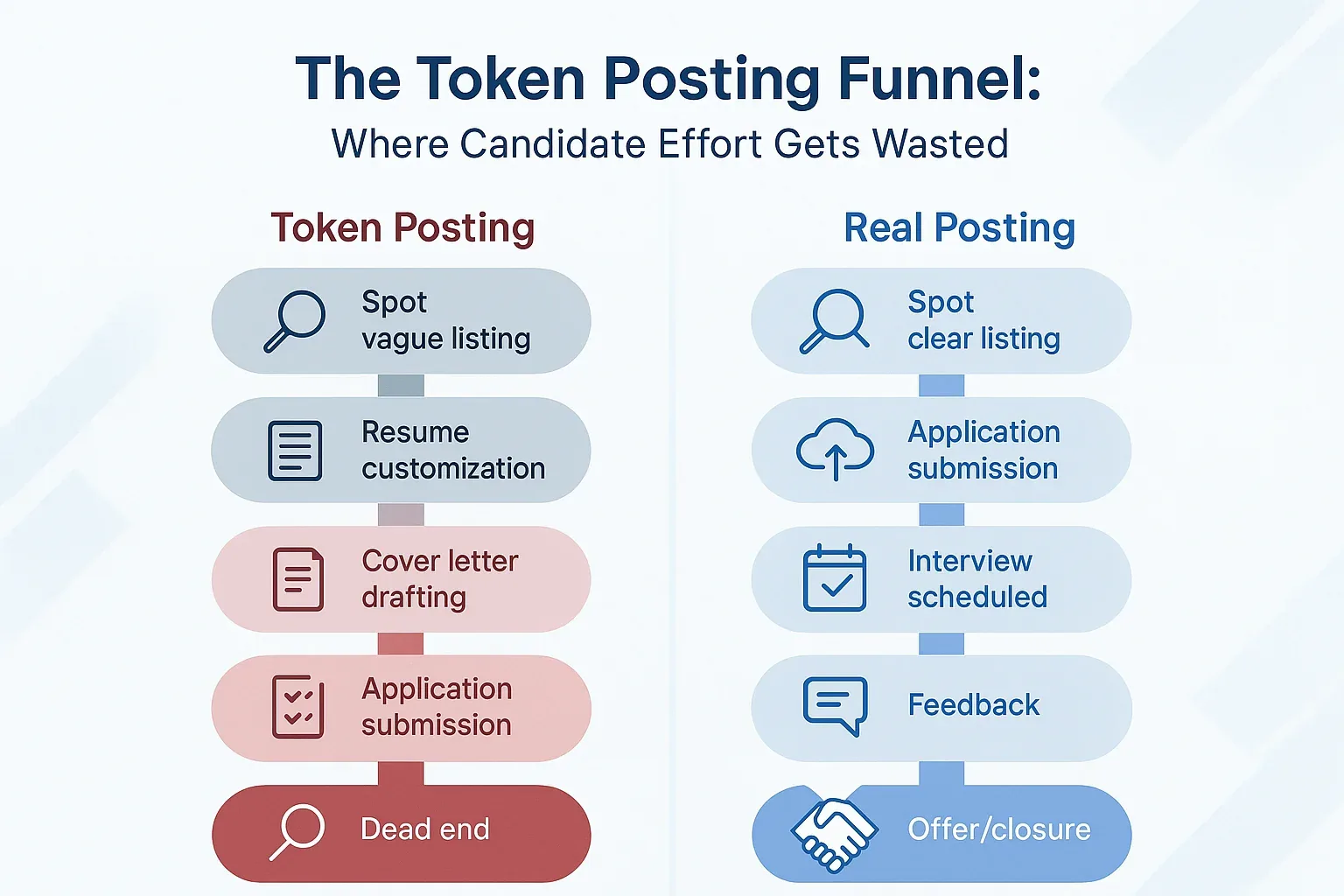
It also adds to the overall sense of burnout that many job seekers feel. Dead-end listings let down more applicants, the less responsive they become, even to legitimate outreach. That hurts everyone involved.
This is one of the reasons job seekers stop trusting recruiters altogether.
How to Spot a Token Job Post Before You Apply
It’s not always obvious, but here are a few signs:
| Red flag | What it might mean |
|---|---|
| No company name listed | The recruiter may not have a real client |
| “Confidential listing” | No accountability for what happens next |
| Job keeps reposting | No movement behind the scenes |
| Vague responsibilities | Not tied to an actual team or project |
| No recruiter contact | You’re unlikely to hear back |
Example of a Token Post:
We’re hiring a full-stack developer for a fast-paced, high-growth environment. Must have 3+ years of experience and be comfortable with modern frameworks. Remote-friendly. Apply now!
No company. No project details. No process. It reads like it was copied from a template.
Example of a Real Post:
Our client’s product team is hiring a mid-level software engineer to support a rebuild of their internal policy automation platform. The role is remote across Canada and uses a stack of Node.js, React, and Postgres. You’ll work with a dedicated QA and report directly to the Head of Engineering. Interviews are scheduled for the week of October 7.
In financial services, we regularly post roles for software engineers for hire who support platform reliability, compliance system rebuilds, and legacy modernization work. These are roles that require a comprehensive understanding.
There’s a clear role, context, and hiring timeline. That’s the difference.
What to Ask a Recruiter Before You Apply
Knowing where the role stands can help you make smarter decisions, and if you’re unsure what to expect from compensation, this recruitment salary guide gives you a realistic range based on your level and function.
If you’re unsure whether a listing is real, here are three simple questions to ask:
- Is this an active role, or are you collecting profiles?
- What stage is the client in with their hiring process? (Intake complete? interviews soon?)
- What does the process look like from here?
A recruiter should be able to answer these without hesitation.
If You’re a Recruiter: What to Do Instead of Token Posting
For example, if you’re sourcing help desk support for hire for a healthcare client, don’t start posting until you’ve confirmed who’s managing the queue, what systems they use, and what the timeline looks like. Vague listings waste time in sectors where responsiveness matters.
There are better ways to build a candidate pipeline:
- Post only for live searches
- Use a lead magnet or opt-in list to attract future interest
- Be upfront about roles that reopen often, and set expectations clearly
Recruiting is a trust-based business. When you misrepresent the basics, that trust disappears.
What Bill 190 Means for Job Postings in Ontario
Ontario’s Bill 190 goes into effect January 1, 2026. STACK IT follows these standards rigorously. Here’s what’s required:
- Public job posts must include a salary or salary range
- Each post must state whether the role is new or an existing vacancy
- Recruiters must disclose AI tools used in screening or evaluation
- Candidates must be notified of final hiring decisions within 45 days
As premium Ontario IT Recruiters, STACK IT has already adopted these practices across every public-facing listing. Compliance isn’t an afterthought, it’s part of how we recruit.
Your Time Matters. Don’t Waste It on Placeholder Jobs.
The reality is that many of the best roles never hit job boards at all. If you want to know where to look and why the strongest opportunities often move off the boards entirely, check out our deep dive on where to find the best IT job opportunities without using job boards.
You’re applying to build something; a better role, a better fit, a better team. At STACK IT, we take job postings as seriously as we do candidates.