

Bill 190 covers several workplace updates across Ontario, but HR teams will feel the impact first in one place: hiring. This post focuses on the parts of the legislation that change how public job postings must be created, managed, and tracked, salary transparency, AI disclosure, vacancy type, candidate communication, and recordkeeping.
If you’re in HR or talent acquisition, this is the clearest explanation of what’s changing and how to prepare.
Before you dive in, we have a more comprehensive resource available. If you want a full, step-by-step compliance checklist, including templates, workflow diagrams, and a 5‑minute readiness scan, we’ve also created a free downloadable Bill 190 resource.
The six Ontario job posting requirements, explained
Bill 190 introduces several new requirements for employers who publicly post a role in Ontario. Here’s a straightforward breakdown.
1. Pay Transparency and Salary Ranges
Pay transparency is quickly becoming standard across Canada. Indeed’s Hiring Lab reported that 49% of Canadian job postings included salary information in February 2024, up sharply from 22% in early 2019.
Every publicly advertised job posting must include either:
- a salary, or
- a salary range.
If you post a range, it cannot span more than $50,000 a year. Above that level the requirement drops away entirely: where the expected compensation is more than $200,000 a year, or the top of your range exceeds $200,000, you do not have to disclose compensation at all. That exemption covers most executive and senior technical search.
This rule applies whether the posting goes on your own site, job boards, or through a platform that distributes your listing.
2. AI Disclosure
Recent data shows how uncommon AI transparency still is. In late January 2025, only 0.29% of Canadian job postings included GenAI‑related terms, suggesting that most employers have not yet updated their templates.
If you use any form of AI to screen, rank, assess, shortlist, or select candidates, you must disclose it.
This includes:
- ATS keyword filtering
- AI‑generated interview notes
- video‑intelligence tools
The disclosure must appear inside the job posting, not in a privacy policy.
3. Vacancy Type
Every job posting must now state whether the role is:
- a newly created position, or
- an existing vacancy.
It’s a simple line, but most templates still don’t include it.
4. No “Canadian Experience Required”
You can’t require, or even imply, that Canadian work experience is mandatory.
Safe replacement language:
“Candidates must be legally eligible to work in Canada.”
5. 45‑Day Candidate Notification Rule
If a candidate has been interviewed, you must notify them of the final decision within 45 days. Where someone is interviewed more than once, the clock runs from the date of the last interview, which is the version that matters for technical hiring with three or four rounds.
nnThe notice may be given in person, in writing, or using technology.
This applies even if they reached only the first interview stage.
6. 3‑Year Record Retention
Employers must retain:
- job postings,
- interview notes,
- AI‑related disclosures,
- and communication logs
for three years.
Where HR Teams Struggle Most
Most teams understand the core requirements, but putting them into everyday practice is where issues show up. Here’s what we see most often:
Inconsistent or outdated salary bands
Ranges vary by hiring manager, market data isn’t refreshed regularly, or the band doesn’t fit the $50K requirement.
Uncertainty around AI disclosure
Teams aren’t sure what “counts” as AI, or how to phrase the statement without over‑explaining.
Missing vacancy classifications
Current templates don’t include this field. Recruiters forget to ask. Jobs go live with missing required language.
No system for tracking 45‑day notifications
Most HR teams rely on inbox reminders or manager nudges. Neither survives turnover or busy periods.
Scattered communication logs
Recruiters and hiring managers send messages from email, Teams, and ATS notes. None of which are archived in one place.
On their own, these issues are minor, but under Bill 190, they can create compliance problems.
What STACK IT Screens For
STACK IT’s hiring workflow already aligns closely with the new requirements. This gives our team context when helping employers adapt.
1. Salary & Range Integrity
Every posting includes a validated range grounded in market data.
2. Clear AI Language in All Ontario Postings
Our standardized disclosure:
“STACK IT uses AI‑enhanced tools to support initial candidate screening and interview note analysis. All assessments and hiring decisions remain human‑led.”
3. Proper Vacancy Classification
We confirm vacancy status during intake and embed it into the posting.
4. Structured 45‑Day Communication Timelines
Workable triggers automated reminders, ensuring no candidate is left hanging.
5. Audit‑Ready Recordkeeping
Interview recordings, notes, and communication logs are retained in a centralized system.
This reflects how our team already works day‑to‑day. Bill 190 simply makes these practices mandatory for everyone else.
A Quick Before/After Example
This approach strengthens your employer brand and keeps processes consistent.
| Before Bill 190 Alignment | After Bill 190 Alignment |
|---|---|
| Posting has no salary range. | Posting includes a compliant salary range. |
| No AI disclosure despite using ATS filters. | AI disclosure is embedded directly in the description. |
| Vacancy type not included. | Vacancy type is labeled at the top of the JD. |
| Candidate emails live in individual inboxes. | All candidate communication is stored in Workable. |
| No systemized reminder for the 45-day rule. | Automated reminders ensure all candidates receive closure. |
What HR Teams Should Do Next
Use this as a practical plan, not legal ad
When these rules took effect: the job posting requirements came into force on January 1, 2026 and apply to employers with 25 or more employees on the day a position is posted. A separate set of new-hire information requirements took effect earlier, on July 1, 2025. Worth knowing if you are checking whether guidance is current: three statutes feed these rules. Bill 149 (Working for Workers Four Act, 2024) and Bill 190 (Working for Workers Five Act, 2024) created the framework, and Bill 30 (Working for Workers Seven Act, 2025) added to it after Royal Assent on 27 November 2025. Guidance published before that date describes only the first two.
The vacancy type requirement has a specific origin worth knowing: according to the Minister of Labour it was aimed in part at ghost jobs, postings employers advertise with no intention of filling.
What Non-Compliance Actually Costs
This is the question we get asked first and it rarely gets a straight answer. The Ontario job posting requirements sit inside the Employment Standards Act, so enforcement runs through the Ministry of Labour rather than a separate tribunal. The requirements themselves live in Part III.1 of the ESA, sections 8.1 to 8.6, with the operating detail in Ontario Regulation 476/24, Rules and Exemptions re Job Postings, which also defines what counts as artificial intelligence, a publicly advertised job posting, compensation, and an interview. In practice complaints are usually triggered by a candidate rather than by an audit, and the first thing an officer asks for is the records you were required to keep for three years.
The recordkeeping requirement is what makes the other five enforceable. A missing salary range is arguable. A missing three-year log of who applied, who was interviewed and when they were notified is not. We break down employer risk and the specific consequences in our guide to AI disclosure under Bill 190, and Bill 149 versus Bill 190 sets out which obligations came from which statute.
vice.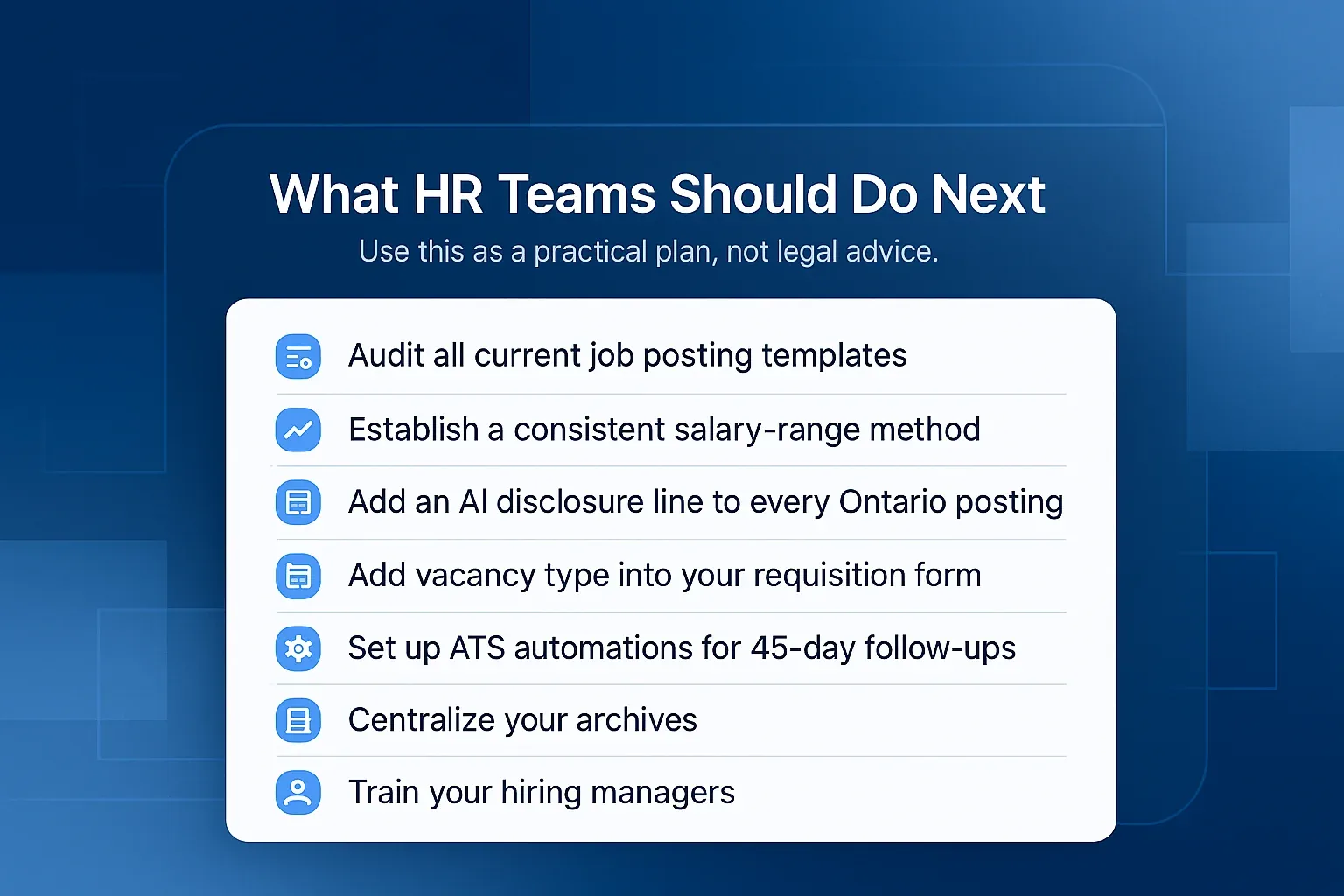
If you want a deeper breakdown, including templates, diagrams, and workflow visuals. Our downloadable checklist covers the full Bill 190 hiring‑compliance system.